
Go for the archaeological story, not a quick photo stop
Choose Sanxingdui if ancient Shu objects and excavation interest you enough to give them three or four hours in a museum. Keep a full day between your Chengdu hotel and the same hotel that night. If your main wish is a living-animal visit, use the Panda Base on a different day; combining the two leaves your return dependent on two long visits and an uncertain transfer.
Sanxingdui is in Guanghan / 广汉, not a wing of Chengdu Museum. The current museum describes the site’s ancient city, the 1986 pits and the discoveries since 2019, while the 2023 new exhibition hall brings those finds into a single main visit. Its visitor introduction names the hall’s three themes: “Century of Pursuit” (世纪逐梦), “Majestic Royal City” (巍然王都), and “Heaven, Earth, People and Gods” (天地人神). This is the core. The separate restoration hall is optional and has different hours.
Visit limits: the excavation site remains closed to public walk-throughs, according to the museum’s FAQ. Jinsha Site Museum’s notice separately closes that Chengdu museum through 30 April 2027. Do not build an imagined two-site “ancient Shu pass” around either of those places.
Direct bus both ways
Start near Chunxi Road and keep a simple museum-stop-to-museum-stop return. Best when the operator displays a usable outbound and return for your date.
Guanghan North, then a road leg
Use a bookable train to Guanghan North / 广汉北 and an arranged local taxi or bus to the museum. Repeat both legs in reverse; the road leg connects the station with the museum entrance.
Admission or return missing
Until museum approval and a workable return are secured, keep a Chengdu city day.
Compare Chunxi Road with another Chengdu hotel base → Keep the same hotel for the city day and plan the final journey to its exact entrance.
Obtain a written reservation before buying the journey
The museum’s live visitor and ticket data presents a separate “Inbound tourists purchase tickets” route. Download the museum’s Booking Form, enter the visit date, name, nationality, ID type and ID number, and email it to wbyy@sxd.cn. Use the exact name and passport number you will carry. The museum says it reviews the form and sends an email receipt saying whether the reservation succeeded. After success, pay at the ticket office on the visit day and present the original booking document for ticket exchange and entry. Proceed with the journey after that email accepts the reservation.
- Pick the museum date before transport. Send the form from an address you can check while travelling. The form asks for identity details; use only the museum-hosted download and its published
@sxd.cnaddress. - Keep the acceptance email. Bring that message and the original passport named in the form, not only a scan. Ask the museum through the same official channel if a child, a second passport or a changed document needs a different booking.
- Plan payment at the ticket office. The museum’s current FAQ lists CNY 72 for an ordinary ticket, but it phrases the general rate around a Chinese ID. Confirm your inbound booking’s payable amount and accepted payment method in the reply. The listed student and other reductions have document conditions; no blanket foreign-student, child or senior concession is assumed here.
The same official data says the standard online day and extended tickets are released at 20:00, five days ahead. That is a rule for those online products; the separate emailed inbound form publishes no matching response deadline or guaranteed allotment. Send it with useful lead time, watch for written approval, and make refundable transport plans until you have it. Third-party ticket and interpretation sellers are unauthorised by the museum; use the museum’s own admission confirmation.
Use a morning reservation. The museum’s visitor data gives ordinary exhibition-hall hours of 08:30–18:00, with entry ending at 17:00 in its English table, and 09:00–18:00 for the restoration hall. Holiday and school-holiday extensions use a different entry period. Use the official announcement list plus your acceptance email for the actual date; the morning plan leaves time for the main hall without relying on an extension.
Choose a bus return before leaving the hotel
For a central Chengdu base, first check the Sanxingdui tourism direct bus / 三星堆旅游直通车 from Chunxi Road. In a 30 August 2026 interview with Chengdu Public Transport Group, Chengdu Daily identifies the official purchase channel as the 成都公交 app or mini-program’s 出行 → 趣耍巴士 area, or the official QR code at the bus door. That report gives CNY 25 one way and CNY 45 round trip as the fare reference published that day; the product for your visit sets the actual fare.
Search the operator channel for 三星堆. Select the actual date, the Chunxi Road / 春熙路 boarding point, and a museum-to-Chunxi return that leaves time for the hall and your walk to the stop. Read whether the selected product is one-way or round-trip and save the issued order. The operator interview places the official Chunxi Road stop under the IFS climbing panda; use the live order’s map pin and bus sign before boarding. If a usable return is missing, arrange a licensed-car return or choose another date.
- Chengdu hotelTravel to the actual Chunxi boarding point
- IFS panda / 春熙路Issued direct-bus outward ride
- Sanxingdui Museum / 三星堆博物馆Ticket office → main hall → optional restoration hall
- Museum bus stopConfirmed return ride to Chunxi
- Same Chengdu hotelWalk, Metro or legal taxi from Chunxi
A schematic of the connections. Arrange museum admission and a ride in each direction.
Rail alternative: search the actual Chengdu origin, Guanghan North / 广汉北 train and return in 12306. At Guanghan North, take a licensed station taxi or an app-booked car to 三星堆博物馆游客中心. Save a return train with a margin for the road transfer. Budget and arrange both local road legs rather than treating the rail ticket as door-to-door.
Which Chengdu rail station you depart from depends on the trains actually offered on your date. A prebooked legal car from your hotel can reduce transfers for a group or limited walking range, with the total price, museum drop-off, return pickup pin and driver contact agreed in advance. Arrange museum admission through its own channel.
Match the admission document at the visitor centre
On arrival at the Sanxingdui Museum stop / 三星堆博物馆站, orient to the signed Visitor Center / 游客中心 and ticket office. The museum places document exchange for successful inbound reservations at the ticket centre. Show the acceptance email and original passport, confirm the date and entry period, pay the amount the office confirms, and keep the issued admission available for the gate. Do not enter a mainland-ID-only queue simply because it appears shorter.
Ask staff for the route to the new exhibition hall / 陈列馆 and the current map. The site is a campus with landscaping and more than one building; its own FAQ places wheelchair and stroller borrowing at the visitor centre and exhibition-hall lobby. If you need an aid, ask where it must be returned before choosing your final building and pickup point. Ask about step-free access along the full station, bus and hall route separately from borrowing an aid.
The museum says no touching exhibits, no flash or selfie sticks in exhibition areas, and no photos where a specific sign prohibits them. A current visitor FAQ supplies these rules. Keep food and a substantial rest outside the gallery path or in permitted visitor-service areas; check on-site signs rather than assuming a café or re-entry privilege.
Follow the story, then spend time with three kinds of object
Allow three to four hours at the museum, including admission, the main hall and pauses. The new hall’s core exhibition moves from a century of archaeological work to an ancient royal centre and then to ritual images. Follow the signed 世纪逐梦 → 巍然王都 → 天地人神 themes when open; they are a better organizing thread than hunting a social-media checklist. The displays can change for conservation or loans, so find the live gallery map before crossing the hall for a particular piece.
- Start with the discovery. Read enough of the early excavation material to understand why the 1986 pits and later pits transformed the picture of ancient Shu. That makes a broken or reassembled object meaningful when you meet it.
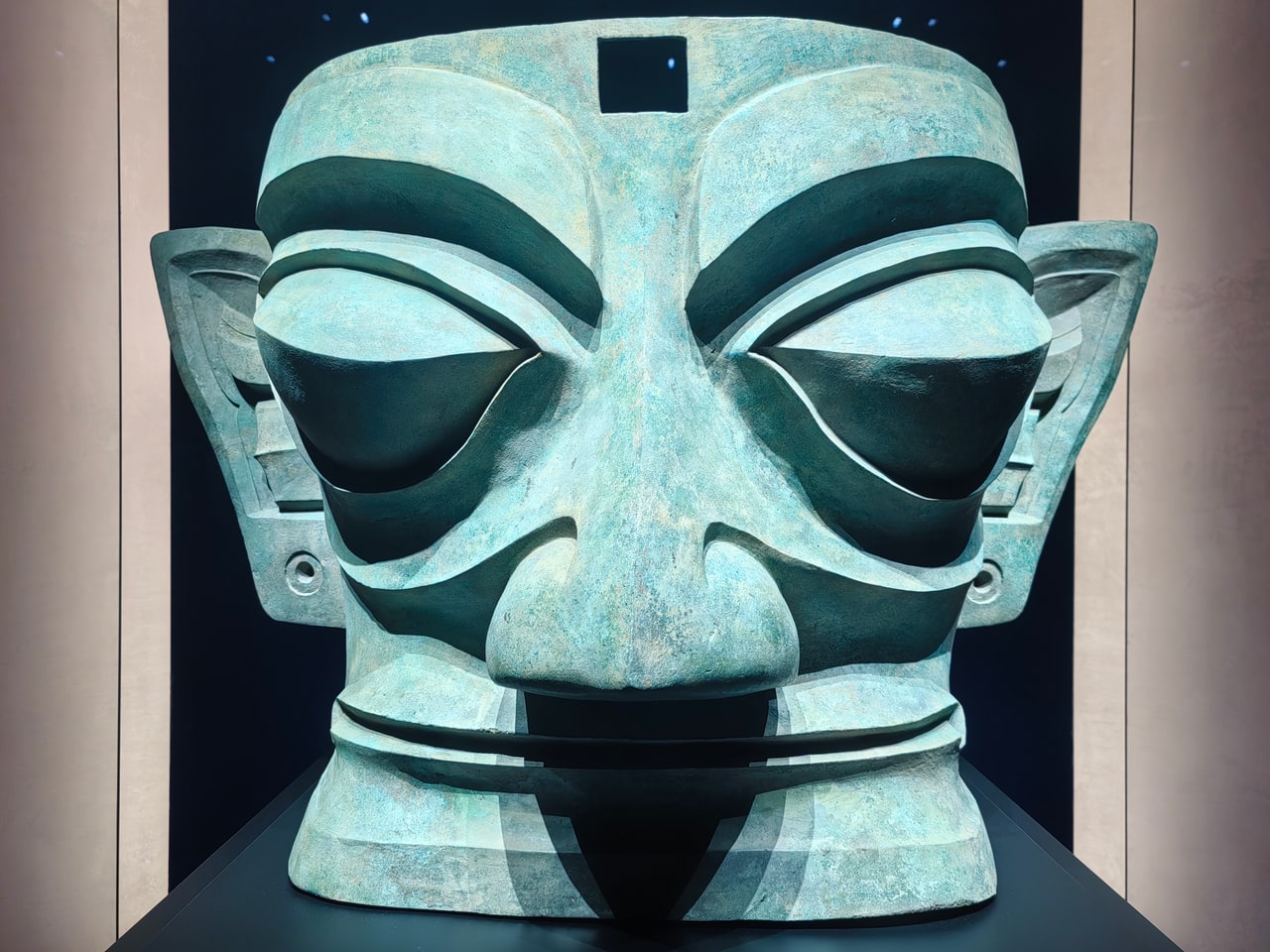
- Compare faces and bodies. The bronze heads and masks differ in scale, eyes and headdresses. The large standing figure invites a slower look at its clothes and ring-shaped hands; the museum’s collection page explains its segmented casting, while the exact identity and use remain interpretations.
- End with the bronze tree and ritual world. The nearly four-metre tree carries birds and a winding dragon. Its form is visible; what it meant is debated even on the museum’s own object page. Leave room to compare the museum’s competing explanations rather than repeating one as fact.
The restoration hall / 修复馆 is a useful addition for a visitor interested in how fragments are studied and conserved. Ask staff whether it is open and how to reach it from the main hall before adding it; the museum’s visitor data gives it a separate closing time and says it keeps its own hours during main-hall extensions. It is the first thing to drop when the return ride or your energy is tight. The actual excavation area remains closed to public visits.
Audio guides are offered in the main hall; the museum’s current service data lists a CNY 30 smart audio guide and a separate CNY 38 MR product. These optional services are paid separately from admission. If a human guide matters, ask the museum about the guide’s language and availability before arranging one.
Leave the final gallery in time for your confirmed ride
Keep the operator order or rail ticket accessible during the visit. Before starting the last exhibition theme or the restoration hall, allow the walk back to the 三星堆博物馆 direct-bus stop or your local-car pickup, plus a queue margin. Use the departure on your issued order to set that turn-back time. The direct bus returns to the Chunxi Road / 春熙路 area, from which you use the exact hotel address for a walk, Metro or legal taxi.
If you came by rail, return from the visitor centre by your arranged licensed or app-booked car to Guanghan North / 广汉北. Leave a margin for the road journey, station security and boarding; board the train at Guanghan North after the road transfer. On arrival at the Chengdu station printed on your ticket, navigate from that specific station to your hotel. Avoid a late train followed immediately by an airport departure.
If the expected bus is unavailable: ask the official bus staff whether your issued ticket can be moved. If it cannot, use your already identified Guanghan North rail alternative with a valid return train and a legal road ride; otherwise arrange a licensed or app-booked car to the Chengdu hotel and agree the full fare before departure. Base that same-night connection on an issued train ticket with its arranged road transfer, or an agreed car pickup. Use the museum’s service line 0838-5533333 for admission questions; book transport with its operator.
Protect the admission and return first
- Only a form submission, no museum acceptance: stay in Chengdu. Chengdu Museum and People’s Park make a city history-and-tea day; use Chengdu Museum’s own reservation route for that visit.
- Outbound direct bus full: switch to Guanghan North only when both train tickets and the station–museum road legs fit the admission period. Proceed with this rail alternative after those final connections are arranged.
- Gallery or restoration hall closed: follow the open main-hall themes, or shorten the visit. The restoration hall keeps its own hours.
- Returning late: cut the optional hall or guided service. If a booked ride is missed, use the operator’s rebooking rule, a genuinely available train plus road transfer, or a pre-agreed legal car. No last bus, train or car fare is invented here.
- Limited walking or a child needing breaks: keep the main hall and a single return point. Confirm stroller or wheelchair borrowing and its return point; consider a reserved car when the bus and station links create too many steps.
Sanxingdui can also be an overnight Guanghan stop when the next morning is used nearby or the travel party wants a slow museum visit, but keeping the Chengdu hotel avoids an extra move on a first trip focused on this museum. An overnight only works after the room, luggage, admission and the following day’s onward route are actually confirmed.
Sources and what remains date-dependent
Checked 29 September 2026. The museum’s public visitor endpoint supplied the inbound form URL, email, ordinary fare, five-day standard online release, FAQ and exhibit themes. Its Chinese banner displays extended hours while the English field retains ordinary hours; the article uses a morning reservation. The official booking-form download contains date, name, nationality, ID type and ID number fields. Follow the official announcement list for temporary arrangements.
The 30 August bus-operator interview confirms the direct-bus product, official sales channel, Chunxi pickup context and then-current fare reference. A departure for your visit still needs an issued order. The rail option uses China Railway’s live ticketing entry for Guanghan North plus a separately arranged road journey; individual train times, local-bus intervals, last returns and exact journey durations remain unestablished for your departure. Museum admission, optional services and transport are separate charges. Secure an issued ride or agreed car pickup for both directions; use the public pages for route identity and rules, and the issued order for your reserved departure.