.jpg)
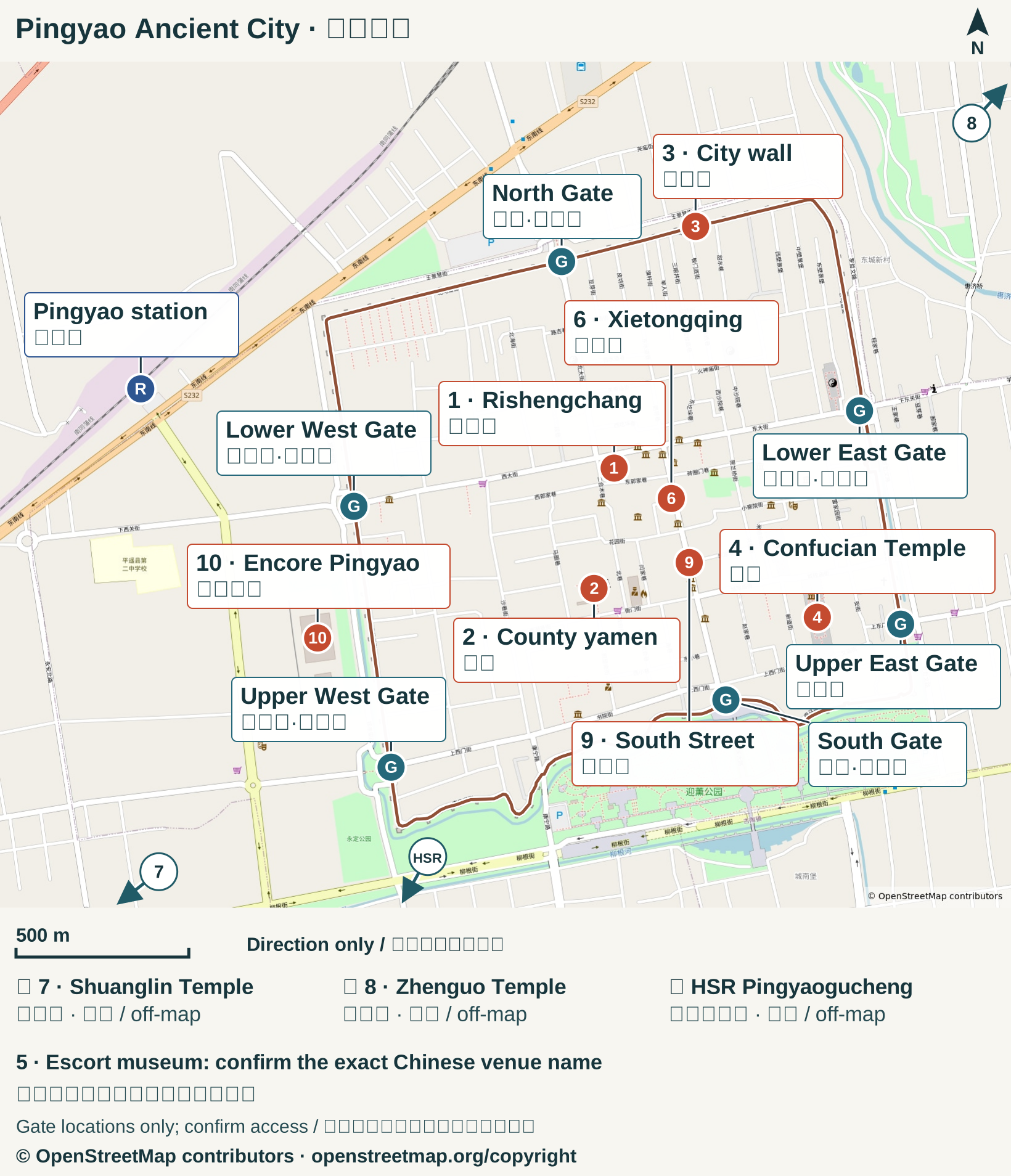
1. Rishengchang
日昇昌
Historic draft bank · West Street
- Full visit
- 1½–2 h room return, editorial plan
- Admission
- CNY 125 listed 1 Oct; final check
- Hours / closures
- See visit details
- Booking / ID
- Town pass; passport gate check
Stay inside the walls: one night for bank streets and courtyards, two if adding an outer temple.
Shuanglin and Zhenguo temples lie outside the walls and have separate gates. Their key halls are under a published half-closure repair notice: decide whether the available view meets your reason for going before arranging the ride.
Historic draft bank · West Street
Historic government compound · southwest old town
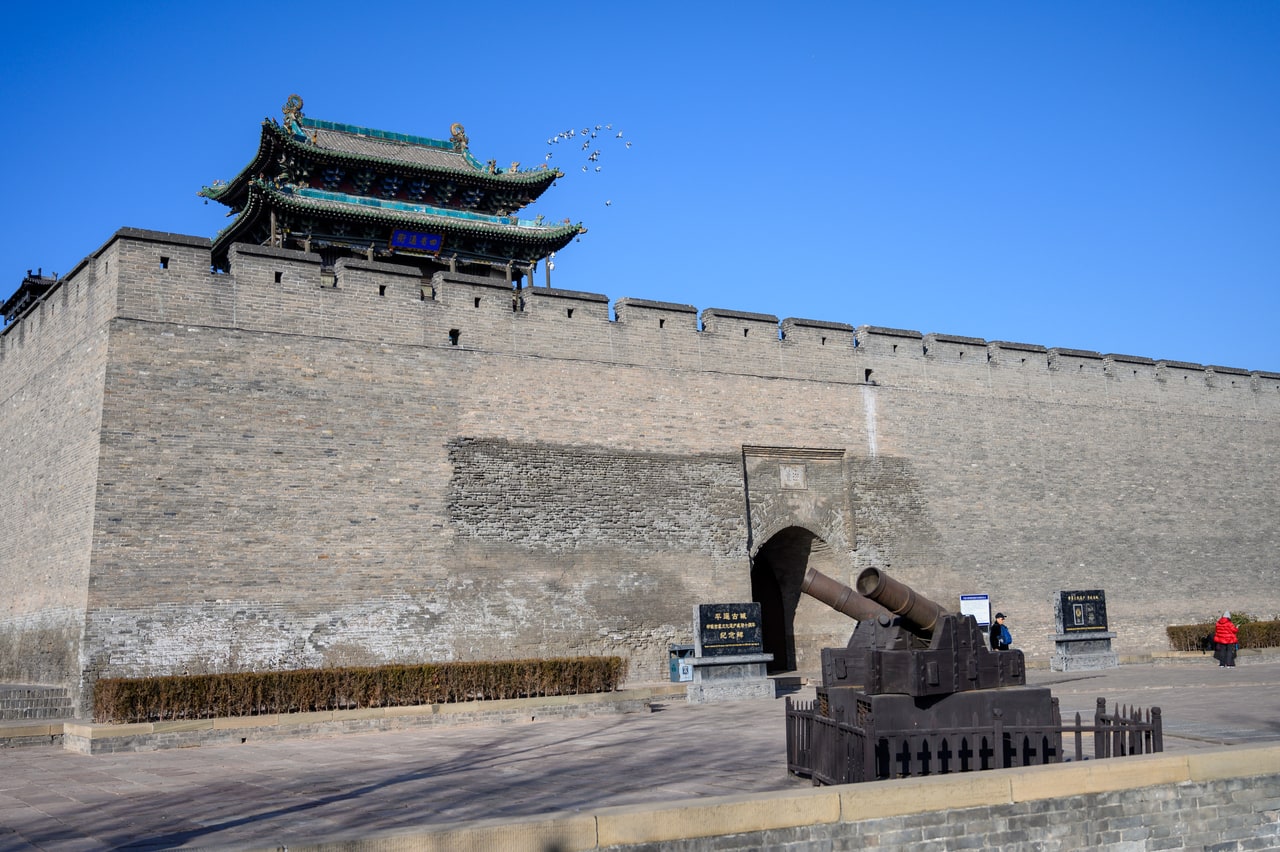
Open wall section and town panorama · signed south or north gate
Optional education and ritual interior · inside the walls; exact gate check
Optional trade-and-transport interior · inside the walls; exact museum check
Alternative draft-bank visit · inside the walls; exact gate check
Painted-sculpture temple · southwest, separate road trip
Early timber hall and temple · northeast, separate road trip
Public food and shop street · inside the walls
Optional walking theatre show · west outside the walls
The experience inside the walls is the relationship between places: a shop facing the street, working rooms behind it, a succession of courtyards, then private living space. Pingyao prospered as a banking centre in the nineteenth and early twentieth centuries. Visit a draft bank to understand that trade, then return to the streets where houses, shops and hotels still share the town. UNESCO describes this surviving urban fabric; it is more than a collection of decorated facades.
West Street 西大街 is the starting point for Rishengchang and the former banking district. South Street 南大街, also called the Ming–Qing street, leads past the City Tower 市楼 toward the southern walls, with restaurants and shops along the way. East Street 东大街 gives a different approach to the centre and access to Jing's Residence. Use the City Tower as an orientation landmark; seeing it from the street and climbing a ticketed city-wall stair are different activities.
Walk the commercial spine once, then turn into a public side lane. Look at carved door lintels, narrow gateways and the depth of the blocks rather than expecting every door to be a visitor attraction. A shut courtyard can be someone's home. Stay on public paths and ask before photographing people or entering a private yard. The contrast between the visitor streets and ordinary lanes is a reason to leave time unscheduled.
Shuanglin 双林寺 is southwest; Zhenguo 镇国寺 is northeast. UNESCO places them about 6 km southwest and 12 km northeast of the county seat respectively. Those are broad location references, not door-to-door road distances. Shuanglin is principally a painted-sculpture visit; Zhenguo is an early timber-building visit. They share the heritage designation with the town, but require two different drives and separate admission. Use the Shanxi route guide to decide how this stay fits with Datong and Taiyuan.
Count usable blocks rather than a ticket's three-day validity. These are editorial time allocations for an independent visit, not operator tour durations. Protect the city walk and the meal-and-bed experience before adding a second temple or another courtyard.
For a separate visit returning to an inside-wall room, budget 1½–2 hours for Rishengchang and 2–2½ hours for the county yamen. These editorial ranges add a conservative walk and ticket-stage allowance to their 45–60 and 60–90 minutes inside; your actual room, queue and chosen streets change the time. Visiting both in one town circuit avoids repeating the room walk.
| Stay length | Visit blocks and conditions |
|---|---|
| One night, town focus: |
|
| Two nights, recommended first stay: |
|
| Three nights, art or architecture interest: |
|
With only a daylight stop, leave luggage with a confirmed hotel or storage service, see one bank interior and a piece of the wall, and eat before returning to the station. Skip both outer temples. If tickets or passport handling remain unresolved, a street-only afternoon still works: West Street → City Tower → South Street → a public lane → dinner. That route delivers townscape, food and a courtyard stay without promising entry to the paid interiors.
Inside the walls is the better base when the old town is the reason for your visit: you can walk out again after a break and see the streets before day visitors arrive. The cost is luggage handling through controlled streets, door thresholds and an older building layout. A hotel outside the walls makes a vehicle pickup easier but puts an extra walk between your room and the evening town. Choose the side of town that serves your actual pickup, rather than assuming every gate works equally well.
A kang is a broad platform-style bed; the room name alone does not mean a conventional queen mattress. Ask how the sleeping platform is heated on your winter dates and whether its access and mattress suit you.
Ask the hotel to confirm the king bed's actual platform and mattress before choosing it over the kang room. Choose by sleeping arrangement and party size. The listing accepts guests from all countries and regions; that is a stated booking policy, not a tested check-in. Send your date, arrival station and late-arrival time through the booking contact, and agree where a car hands you and the bags over to the hotel.
Choose it for a more spacious courtyard base near the east–west commercial streets. Its location is convenient for the central walk but still requires a planned final luggage leg.
Contact +86 354 584 1000 or reservation@jingsresidence.com for the room and a dated transfer quote. Ask which gate, who carries the bags and whether the entire room route is step-free if needed. First-floor inventory does not establish a step-free entrance.
For either stay, select your dates and occupants before comparing the total: room type, breakfast, cancellation, heating or cooling, and pickup charge. Public room descriptions establish options; they establish neither inventory nor the final payable rate. Keep the hotel's Chinese name and address offline so a driver can distinguish the property from similarly named inns.
The ticket buys the designated interiors and the wall ascent. A government-published April 2025 visitor report describes the 22-site pass and visitor-centre sales; its historic advice is corroborated by a currently readable seller product, rather than being treated as a 2026 reservation rule.
The package says three days from the selected visit date, with each listed site entered once, and excludes Shuanglin and Zhenguo. Its generic voucher label also refers to the selected date: start on the date booked and retain the issued confirmation for the multi-day site visits. Listed sites include the wall, Rishengchang, county yamen and several other bank, temple and escort-agency museums. A pass is useful for a selective route; it does not oblige you to finish the list.
Before paying, ask that seller whether your passport type and nationality are accepted, which original document to carry and where any ticket exchange happens. A Chinese-ID-only form is not an invitation to use someone else's number. The theatre product below has a published passport exchange instruction; that instruction belongs to the theatre alone.
These are listing-derived contacts, not a successful call. Before travelling to a desk, ask for the active foreign-passport counter, its precise gate/address, today's hours, the price, and whether a reservation is required. Show this question to a hotel receptionist if you need help: 外国游客持护照原件,今天在哪里买古城通票?哪个游客中心或窗口?需要提前预约吗? It asks where to buy today with an original passport and whether advance booking is needed. Go to the named counter only after the answer supplies that route.
Decide child, student or senior tickets with the supplier using the traveller's actual foreign document; a domestic concession label alone does not settle eligibility. If neither online conditions nor the visitor-centre route can be established, keep the free street-and-stay plan and defer paid interiors rather than assuming an entry scan will work.
The word Ancient City in a station name does not put the platform beside your courtyard. Search the exact terminal on China Railway 12306 and send the full Chinese station name to the hotel. A quick rail ride from Taiyuan still leaves the station, road transfer and final gate-to-room leg.
If the pickup falls through, use the station's signed taxi area or a licensed ride booked to the hotel-agreed gate, then phone the hotel for the final approach. Do not ask a driver to improvise entry to restricted streets. Allow an editorial planning block of an hour from the high-speed platform to a checked-in room, and more on a crowded date or with a delayed pickup. This is a buffer for leaving the station, driving and handling bags, not a measured journey or a fixed taxi fare.
Bus 108 appears in older transport information, but a current operator timetable, fare and last departure were not established in this review. Use it only after station staff identify the operating line, destination stop and final walk for that day. If you arrive late or have an imminent reservation, a confirmed car is the more dependable plan than budgeting around an old bus schedule.
After a flight, either book a through road transfer to the hotel's agreed gate or arrange an airport-to-railway transfer and a separately booked train to the exact Pingyao terminal. Check the flight's arrival margin against the train; a last train with no recovery leaves the airport transfer deciding the whole evening. A Taiyuan overnight is sensible if the connection is tight, with Pingyao reached the following day.
Electric visitor vehicles can shorten a street leg but do not remove the interior thresholds and courtyard walking. Agree destination and fare before riding. For either outer temple, arrange the pickup and return as one agreement; the town's short local rides and a rural temple return are different transport tasks.
A draft bank, or piaohao, made it possible to remit money through a branch network instead of carrying silver the whole way. Rishengchang supplies the business story behind the townscape. The Ctrip visitor listing explains a progression from front counter and accounts rooms to offices and rear accommodation. Spend 45–60 minutes following that change from public business to private space, then compare the narrow street frontage with the courtyards behind it.
The choice of what to look for matters more than the label first bank: notice where a customer stood, where records were kept and how staff lived on the premises. Interpretive displays may need a Chinese-to-English translation tool. If booking a guide, ask for an explanation of remittance and the room functions in English, and agree the fee and duration before beginning.
Use it as a posted schedule to recheck for your chosen date, especially around seasonal changes; arrive earlier than last entry to allow a real visit. With one short block, this bank is the better first interior than visiting several similar commercial courtyards.
Its main halls, successive gates and inner residential area show how a county office organised official authority and daily life. The historic government description identifies the public main hall, second hall and inner rooms; walk the central sequence and compare it with the bank's customer-to-private progression.
Choose the architecture even if you miss it; avoid building the whole morning around a performance time copied from an old guide. Have lunch and a room break rather than adding every courtyard between the yamen and the southern gate.
The wall view turns an earlier street walk into a readable plan: low tiled roofs, courtyard depth, straight commercial streets and the outer edge of the town. Ctrip describes ascent and descent through the south or north gates, subject to daily adjustments. Ask at the entry which section and descent stair are open before committing to the walk.
A street view of the fortifications and a walk beside the gate remain a different, lower-effort experience.
If the pass and opening allow, choose the town's 4. Confucian Temple 文庙 for education and ritual architecture, or an 5. escort-agency museum 镖局 for the physical transport-and-protection side of trade. 6. Xietongqing 协同庆 is another bank choice if finance is your interest; replace a less interesting stop with it instead of collecting banks out of obligation. All are choices within the seller's pass list, while Shuanglin and Zhenguo remain outside it.
The main visitor streets include costume-photo and souvenir businesses; you can pass them without purchasing an activity. A quiet lane and a return to your own courtyard are part of the visit, not empty time between ticketed sites.
Choose Shuanglin if human expression, robes and the arrangement of painted figures interest you more than another bank courtyard. UNESCO records more than 2,000 surviving Ming–Qing painted sculptures. Look for differences between faces and postures in the accessible halls, and for figures grouped around a main image rather than displayed one by one in museum cases. The art remains in a temple setting, so low light and a restricted viewpoint are part of the viewing conditions.
The Thousand Buddha Hall 千佛殿 is under a half-closure repair notice. Klook carries a notice attributed to the county relics office dated 7 July 2026, with work scheduled July 2026–September 2028. Treat the celebrated Weituo view in that hall as conditional. A 17 July public news reproduction says other halls remain open, but today's exact viewing barriers were not inspected. Ask 千佛殿今天能看到哪些彩塑?韦驮能看清吗?其他殿正常开放吗? — which sculptures can be seen today, whether Weituo is clearly visible and whether the other halls open normally.
Trip.com lists Shuanglin ticket inquiries at +86 354 577 9023 and +86 354 567 3200. Ask for the current opening/last-entry time and foreign-passport purchase route as well as the hall access. Its readable public listing currently posts 08:00–18:30 with last entry 18:15; use the answer for your date rather than assuming that schedule persists into winter.
Qunar's Ctrip-supplied Shuanglin adult product displayed from ¥33 on 1 October. This is a seller offer, not a proved counter tariff or passport booking route. It is separate from the town pass. Before paying, establish the accepted document and date, cancellation and exchange conditions. If using a counter after confirmation, bring the original passport and pay for this temple's ticket, not another town pass.
Use a half-day block with about two hours at the temple for an unhurried first look; take longer if the accessible sculpture is your main interest. Confirm a driver wait or a specific return meeting point before leaving town. Do not count on a car appearing when you walk out. If the restricted hall is the only work you came to see, postpone this outing; otherwise the remaining sculpture can still earn the journey.
Zhenguo is the more specialised choice. Its Wanfo Hall 万佛殿, dating to the Five Dynasties period, is one of China's important surviving early timber buildings. The roof mass, projecting eaves and brackets are the reason to slow down here. Compare how the hall is supported with the much later courtyards you have walked in town, rather than expecting a large temple complex or a second Shuanglin-style sculpture circuit.
Wanfo Hall is also under the seller-carried half-closure notice, with work scheduled July 2026–September 2027. An exterior architectural view and an unobstructed interior sculpture view are different promises. Before hiring a car, ask 万佛殿今天可以进殿吗?彩塑能近看吗?外观是否有围挡? — can visitors enter, see the sculptures close up, and view the exterior without barriers? If the interior is essential and unavailable, remove Zhenguo and use the time for Shuanglin or the town.
Trip.com lists the temple inquiry number +86 354 584 8041; the number and public page were read, but a call was not made. Confirm that day's last entry, ticket counter and passport handling. Qunar's Ctrip-supplied Zhenguo adult ticket displayed from ¥23 on 1 October, separately from both the town pass and Shuanglin. Price and product availability do not prove a foreign-passport entry scan.
Allocate 60–90 minutes on site plus the arranged round trip, longer for close architectural study. The northeast approach is distinct from Shuanglin's southwest road. With both in one day, ask a driver to quote the complete town → temple → temple → town loop, including waiting, parking and the agreed return. With an early onward train, choose one temple or neither; the return road belongs inside your station buffer.
Try the foods in a meal you can finish rather than ordering every local name.
The Chinese names below are useful to show at the counter; preparations and accompaniments differ.
The Ctrip restaurant listing places the main branch at 南大街73号, near the City Tower, and lists Pingyao beef, beef kaolaolao 牛肉栲栳栳, knife-cut beef noodles 牛肉刀削面 and cold wantuo 凉拌碗托.
Its listing gives 南大街84号 and names aged-vinegar braised beef 老陈醋焖牛肉, yellow-millet cold cake 沁州黄米凉糕, wantuo 平遥碗秃 and sour-soup oat noodles 酸汤莜面鱼鱼.
This is an alternative meal on the same restaurant strip, not a second destination you must visit after Tianyuankui.
The listings establish addresses and dish names, not a tasted endorsement or a guaranteed kitchen opening. Use the displayed menu on arrival; skip the queue for the other named restaurant if one is busy. After eating, follow a public side street back toward your hotel. For a souvenir, sealed beef or vinegar is a purchase choice with a label and price; check your destination's food-import rules before carrying meat across a border.
The indoor show is a staged merchant-family story with movement between performance spaces, rather than an ordinary seated concert. Choose it if theatre adds something to your courtyard stay; keep the street dinner and an evening walk if you want a quieter night.
The public product also shows an inconsistent shortened address elsewhere, so use the confirmed ticket's location and a hotel-agreed gate-to-theatre approach.
Get the selected performance's actual change/cancellation terms before paying; plan as a fixed-date ticket unless the supplier settles the conflict. The posted ordinary weekly schedule is not a guarantee for holidays or extra performances.
The name-and-number process is a published product condition, not a completed purchase or a tested passport scan. Book early enough to receive the confirmation rather than treating a same-evening advertisement as a seat.
The exposed rampart is a different effort from a shaded courtyard. Carry water and choose a short wall section instead of aiming for a circuit.
Wear shoes that grip wet paving. Obey any wall restriction, and avoid turning a rural temple transfer into a race against poor road conditions. An indoor theatre performance is an option only if its confirmed time and the walking format suit you.
Allow a warmer meal break between interiors, and remove the wall ascent if steps are icy or closed. A winter town visit can work without a rampart walk; snow is a possibility, not a bookable experience. In windy weather, use shorter exposed walks and carry a layer.
Quiet early streets are a reason to sleep here; early does not mean the interiors open before their posted hours. With heavy queues, choose one good bank visit, the yamen or wall, and dinner. Cut repeat courtyards first, then the optional show, then the second outer temple. Preserve the reason you came and the return journey.
A repair notice is a separate decision from weather.
Avoid compensating for a restricted highlight by paying for more unrelated sites.
The return begins at your room or luggage store, not when the taxi passes the city wall.
It includes the final street leg, road transfer, station security and a margin for a foreign document at a staffed gate. This is a conservative planning choice, not a measured station transfer or railway deadline. Add time on crowded days and follow any earlier arrival requirement shown on your ticket.
Do not put an unconfirmed Zhenguo return before that buffer.
Search the dated onward pair on 12306 for Taiyuan, Datong, Xi'an or the next destination; direct trains, changes and seats vary by date. In a wider heritage trip, use Shanxi's Datong–Taiyuan–Pingyao choices to decide whether Taiyuan earns a stay or serves as an interchange. A confirmed departure is the point at which another temple fits — or gets removed.
Public sources and seller product text reviewed 1 October 2026. Visit lengths, night counts, walking order and transfer buffers are editorial allocations. Room stock, ticket issuance, payment, foreign-passport scans, actual check-in and today's hall visibility were not tested. Public telephone numbers were read, not called.
Editorial update : Added a diagram distinguishing the town walk and two temple roads. Practical source dates are recorded separately above.